
LOL MMR Checker: Find Your Hidden League of Legends Rating
Riot Games never shows you your real matchmaking rating. What you see in the client, your tier, your division, your LP, is only a public-facing approximation of it. Two players can sit in the exact same rank and gain completely different LP for the same win, and the reason almost always traces back to this hidden number.
This MMR checker estimates that number using the stats you already know. Enter your current rank, division, LP, and recent win rate, and the tool works out whether your hidden rating is running ahead of your visible rank, behind it, or right in line with it, plus what that means for your next few games.
How the MMR Checker Works
- Enter your ranked stats. Your current tier, division, League Points, and your win rate over your recent ranked games. No login, no linked account, no summoner name needed.
- The tool calculates a baseline. It places your rank and LP inside the known MMR band for your tier, then adjusts that baseline using your win rate.
- You get an estimate. An approximate rating, how it compares to your visible rank, and what that gap is likely doing to your LP gains and losses.
Because Riot's real formula is proprietary, no external tool (including this one) can show your exact MMR. What it can do is give you a reliable directional read: are you under-ranked, over-ranked, or right where you belong.
What Is MMR in League of Legends?
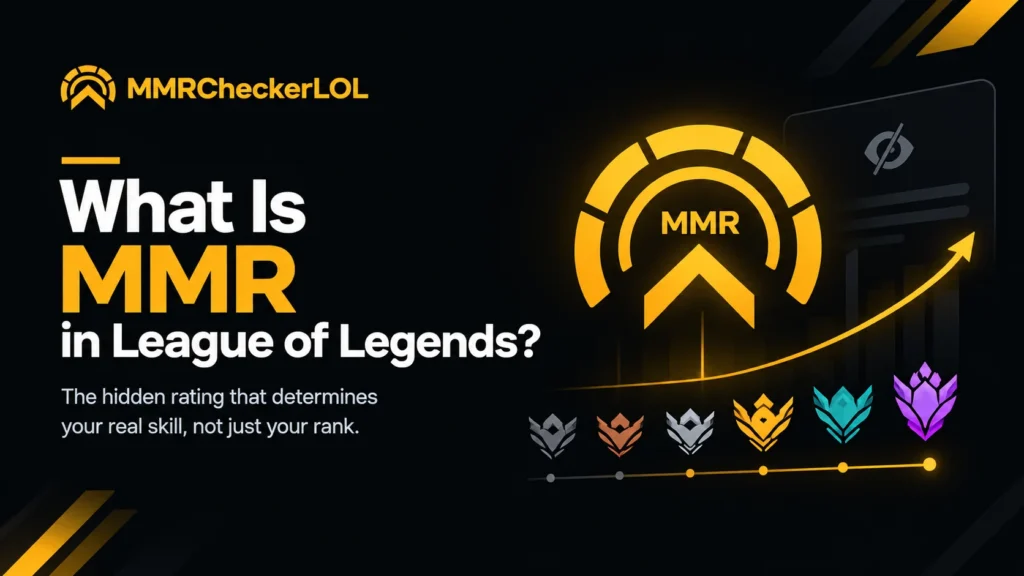
MMR stands for Matchmaking Rating. It's the internal number Riot's servers use to decide who you play with and against: win a lot, and it rises; lose a lot, and it falls. Riot's own support documentation describes it as the value used to determine your place on the ladder and match you with similarly skilled players. Your visible rank exists specifically as a more digestible stand-in for that number, since the raw rating is stripped of the context that makes it meaningful outside the matchmaking system itself.
A few things about MMR are worth knowing upfront:
- It's completely hidden. There's no menu, tab, or profile page anywhere in the League client that displays it.
- It's queue-specific. Ranked Solo/Duo, Ranked Flex, and Normal games each run on their own separate MMR. A Platinum Solo/Duo player can have a Gold or a Diamond Flex rating, and neither number borrows from the other, aside from Normal MMR feeding into your very first ranked placement.
- Only wins and losses move it. KDA, CS, vision score, and damage numbers don't touch your MMR directly, though beating a higher-rated team moves it more than beating a lower-rated one.
- It predates the modern rank system. Before Season 3, League displayed a visible number called Elo, borrowed from the chess rating system designed by Arpad Elo. Riot replaced that visible score with the current hidden MMR paired with a tier and division structure, which is why longtime players still occasionally call their rating "elo" out of habit.
MMR vs. Rank vs. LP: How the Three Fit Together
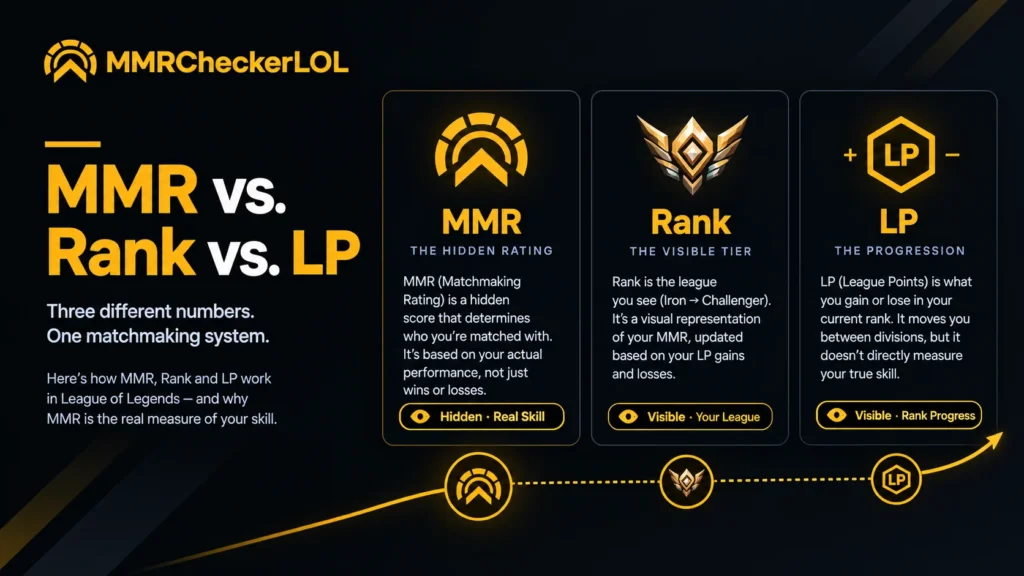
These three terms get used interchangeably, but they aren't the same thing.
| Term | What it is | Who sees it |
|---|---|---|
| MMR | Your real, hidden skill rating | Nobody, not even you |
| Rank | Your tier and division (Iron through Challenger) | Everyone, on your profile |
| LP | League Points, the currency that moves your rank up or down | Everyone, updated after every game |
Rank is built almost entirely out of LP, and LP is the bridge Riot uses to slowly drag your visible rank toward your real MMR. When the two are aligned, your LP gains and losses stay close to even. When they drift apart, LP becomes the correction mechanism: bigger rewards and softer losses pull an under-ranked player up, while smaller rewards and harsher losses pull an over-ranked player back down. This is also why raw win rate can be a misleading way to judge your climb. A 55% win rate that's producing shrinking LP gains often just means your MMR and rank have already caught up with each other, not that you've stopped improving.
How Is MMR Calculated in League of Legends?
Riot has never published the exact formula and treats it as proprietary, which is exactly why third-party checkers exist in the first place. What's publicly documented, and what this tool's estimate is built on, comes down to a small number of confirmed mechanics:
- Your MMR moves up after a win and down after a loss, weighted by the strength of the opponents you beat or lost to.
- Your rank is the visible proxy for MMR, and the gap between the two sets your LP swing on every game.
- When MMR and rank are equal, LP gain and loss sit close to symmetrical.
- When MMR is above rank, wins are worth more LP and losses cost less. The system is actively pushing you up.
- When MMR is below rank, wins are worth less and losses cost more. The system is pulling you back down until the two re-align.
This checker works backward from that same logic. It starts from your current tier and division as a baseline, then adjusts the estimate using your recent win rate: a sustained win rate meaningfully above 50% signals your MMR sits above your displayed rank, and a win rate below 50% signals the opposite. The result is an estimate, not a certainty. Nobody outside Riot's own servers can produce the real number.
It's worth mentioning the older community term "Elo hell" here too, since it comes up constantly in the same conversations as MMR. It describes the belief that a player can get stuck at a low rank purely because of bad teammates, regardless of their own skill. Riot's designers have generally pushed back on the idea as a cognitive bias more than a real system flaw, and the mechanic above explains why: a genuinely skilled player who keeps winning will see their MMR pull away from their rank quickly, which then accelerates their climb through bigger LP gains. Smurf accounts climb fast for the same reason. A new account with no MMR history swings hard after every early win or loss until the system locks onto roughly where that player belongs.
Estimated MMR Ranges by Rank
Because Riot doesn't publish MMR on a fixed public scale, there's no single official number separating Gold from Platinum. What third-party tools, including this one, use instead is a community-standard reference scale, cross-checked against how many players actually occupy each tier. Treat the numbers below as a rough guide to where you sit relative to other players, not as an exact figure Riot would recognize.
| Tier | Approx. MMR range | Share of ranked players (NA, Solo/Duo)* |
|---|---|---|
| Iron | ~600-900 | ~4% |
| Bronze | ~900-1,150 | ~17% |
| Silver | ~1,150-1,400 | ~22% |
| Gold | ~1,400-1,650 | ~24% |
| Platinum | ~1,650-1,900 | ~18% |
| Emerald | ~1,900-2,150 | ~12% |
| Diamond | ~2,150-2,450 | ~3.6% |
| Master | ~2,450-2,650 | ~0.7% |
| Grandmaster | ~2,650-2,850 | ~0.05% |
| Challenger | ~2,850+ | ~0.02% |
*Population shares are an approximate snapshot of the NA Solo/Duo ladder and shift a little every patch and every region. Korea, for instance, skews meaningfully higher than NA or EUW at every tier. Gold isn't the "average" rank it feels like: with roughly half the ladder sitting in Iron through Silver, reaching Gold already puts you ahead of a majority of ranked players.
Each tier from Iron through Diamond is split into four divisions. Master, Grandmaster, and Challenger share one continuous LP ladder with no divisions at all, so your position there is decided purely by LP.
Why Do I Gain Less LP Than Others?
This is the single most common source of ranked frustration, and it's almost always the same mechanism at work: your rank has out-paced your MMR.
If you're seeing +14 or +15 LP on wins but losing -20 or more on defeats, the system currently believes you're sitting above your actual skill level, and it's using LP to correct that: smaller rewards, bigger penalties, until your win rate either proves it wrong or your rank drifts back down to meet it. This typically shows up right after a losing streak, since rank falls slowly (division and demotion protections soften the drop) while MMR reacts to losses much faster underneath it.
The fix isn't complicated, even if it isn't fast. String together more wins than losses. A sustained win rate somewhere in the 55%+ range over 20 to 30 games is generally what it takes to visibly close the gap. There's no shortcut, no reset button, and no setting that fixes it instantly. Riot's own guidance is explicit that this is a "win a lot of games in a row" problem, not a one-game fix.
A few things don't affect this gap, contrary to popular belief:
- Dodging champion select doesn't touch your MMR at all. It only costs LP and queue time.
- Your KDA, CS, or damage numbers aren't part of the calculation. Only the win or loss is.
- Individual performance within a loss won't soften the LP hit, since Riot's matchmaking is built around team outcomes, not solo stats.
Solo Queue MMR vs. Flex MMR vs. Normal MMR
League of Legends runs a genuinely separate MMR for every queue type. Riot’s own support documentation confirms Solo/Duo, Ranked Flex, and Normal games are each tracked independently. That means:
- Your Solo/Duo MMR and your Flex MMR are separate ratings. Flex games include premade groups, which changes the skill dynamics enough that Riot deliberately keeps the two ladders apart. Riot’s 2026 ranked updates have brought Flex ratings closer to Solo/Duo, so big gaps are now less common than they used to be. A gap can still appear if you’ve played one queue far more than the other.
- Flex can’t raise your Solo/Duo rating. Riot has confirmed that Flex will never push your Solo/Duo MMR upward, so winning in Flex won’t help you climb in Solo/Duo.
- Normal MMR matters once. It’s factored into your very first ranked placement matches, before you have any ranked-specific data for the system to use instead.
- A losing streak in one queue doesn’t directly affect the other. A rough run in Flex has no direct effect on your Solo/Duo rating, and the reverse is also true.
If your Flex rank looks different from your Solo/Duo rank, that’s normal, not a sign something’s broken. The two ratings are built from different match populations and, especially at higher ranks, different play styles. Coordinated five-stacks behave very differently from five strangers who queued solo. For a deeper breakdown, read our guide on Solo Queue MMR vs Flex MMR.
Does MMR Reset Every Season in League of Legends?
Not fully. Riot uses what's usually described as a soft reset. Your rank and LP visibly drop at the start of a new ranked year, and you're required to play placement matches again, but your underlying MMR isn't wiped. It carries forward, just pulled partway back toward the middle of the ladder.
Read our full guide: Does MMR Reset Every Season in League of Legends?
The community's long-standing approximation for that pullback is roughly:
New ranked year MMR is about equal to (Old MMR + 1200) divided by 2
This is a community estimate, not an official Riot formula.
Riot has never published this as an exact public formula, so treat it as a reasonable estimate rather than a guaranteed number. The direction is confirmed by Riot's own explanation of the mechanic, though: since your MMR starts the new ranked year essentially where it left off (just softened), while your visible rank starts much lower, the gap between the two is usually at its widest right after a reset. That's exactly why placement games and the first stretch of a new ranked year tend to produce unusually large LP gains for returning players. The system is racing your rank back up to meet an MMR that barely moved.
How to Increase Your MMR in League of Legends
Since wins and losses are the only real input, improving your MMR really means improving your win rate over a meaningful sample of games. A few approaches that consistently help:
- Narrow your champion pool. Players who commit to two or three champions tend to outperform players who swap picks every game. Ranked isn't the place to experiment with something new.
- Take a break after a losing streak. Two or three losses in a row is usually the point where decision-making starts to degrade. Coming back fresh for a real winning stretch does more for your MMR than pushing through five straight losses on tilt.
- Dodge bad lobbies when it's clearly warranted. A duo already flaming in champ select or a teammate on a visible loss streak is a legitimate reason to dodge. It costs LP and queue time, but your MMR stays completely untouched either way.
- Prioritize win rate over volume. Thirty games at a 55%+ win rate moves your rating further than a hundred games hovering around 50%. Quality sessions beat marathon grinding.
- Play your primary role when you can. Familiarity compounds. Being autofilled occasionally is unavoidable, but building consistency in one or two roles gives you a more predictable, and generally higher, win rate.
Frequently Asked Questions
What does MMR mean in League of Legends?
MMR stands for Matchmaking Rating, the hidden number Riot uses to match you against opponents of similar skill and to determine how much LP you gain or lose. It's never shown anywhere in the client.
How do I check my MMR in League of Legends?
Riot doesn't publish it anywhere, so there's no in-client way to see it directly. Third-party tools like this one estimate it from public data, namely your rank, LP, and recent win rate, which is the same basic approach every reputable MMR checker uses, since none of them have access to Riot's actual backend number.
What's the difference between MMR and LP?
LP is the visible score that moves your rank up or down, gained on wins and lost on defeats. MMR is the hidden rating underneath it that actually determines how much LP each of those wins or losses is worth. When they're aligned, LP swings stay close to even. When they're not, LP becomes the mechanism pulling your rank back toward your real MMR.
Is normal MMR the same as ranked MMR?
No. Normal games, Ranked Solo/Duo, and Ranked Flex each have their own independent MMR. The only crossover is that your Normal MMR contributes to your very first ranked placement, before the system has ranked-specific data to work with.
Does queue dodging affect MMR?
No. Dodging in champion select doesn't touch your hidden rating. It only costs you LP and a temporary queue-time penalty, which makes it a legitimate way to avoid a bad lobby without harming your MMR.
What is the Climb Indicator?
It's a feature Riot added to the client that flags players whose hidden MMR is running ahead of their visible rank, useful context for a teammate who looks under-ranked but is actually already climbing. It doesn't reveal an exact number, just that the gap exists.
What is Aegis of Valor?
It's a Riot system that doubles your LP gain on a win when you're playing an autofilled game or a priority role like Support or Jungle, provided you play the role reasonably well. It's meant to offset the disadvantage of not getting your preferred position.
What is a good MMR in League of Legends?
"Good" is relative to the ladder you're on. Reaching Gold already puts you ahead of roughly half of ranked players, and Platinum and above sits in the top quarter or so of the ladder. There's no universal numeric threshold, since it depends entirely on region and queue.
What's the difference between ELO and MMR?
Elo was the visible rating system League used through Season 2, shown directly on your profile. Riot retired it in favor of the current hidden MMR paired with the visible tier and division rank system, though the two work on a broadly similar win and loss principle.
Can I check someone else's MMR?
Yes. Just enter their rank, division, LP, and recent win rate instead of your own if you know a duo partner's or opponent's stats from their profile or match history, you can run the same estimate for them.
How accurate is this MMR checker?
It's an estimate, not the real number, since no third-party tool can access Riot's actual backend value. What it can do reliably is tell you the direction of the gap between your MMR and your rank, based on your current tier, LP, and recent win rate, which is the same public signal every legitimate MMR estimator relies on.